


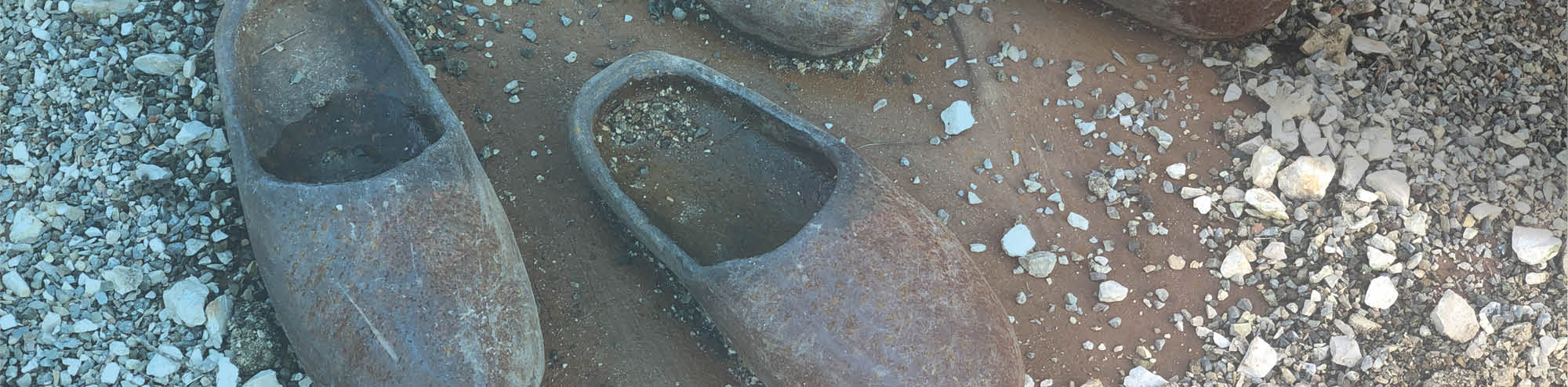
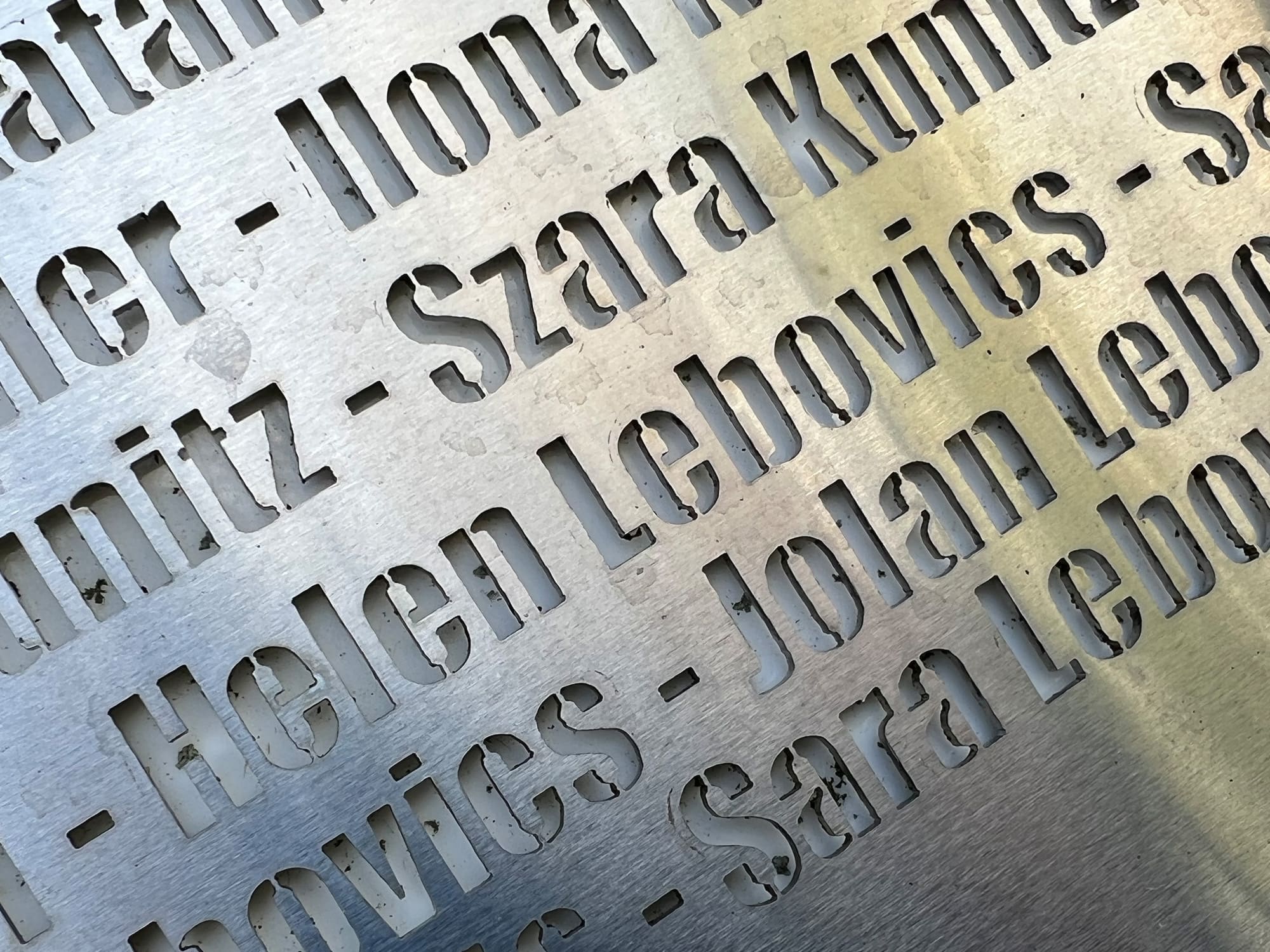
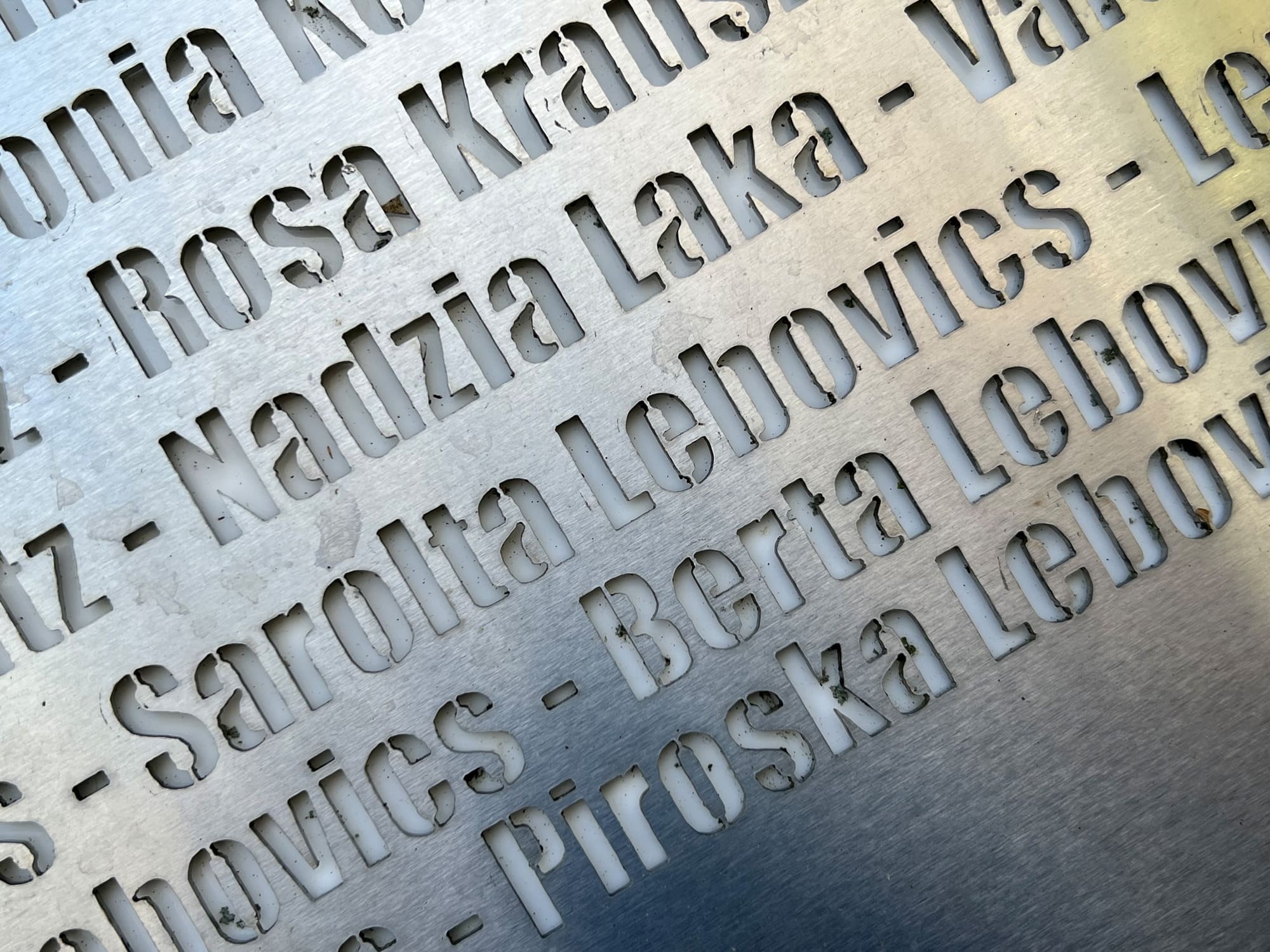
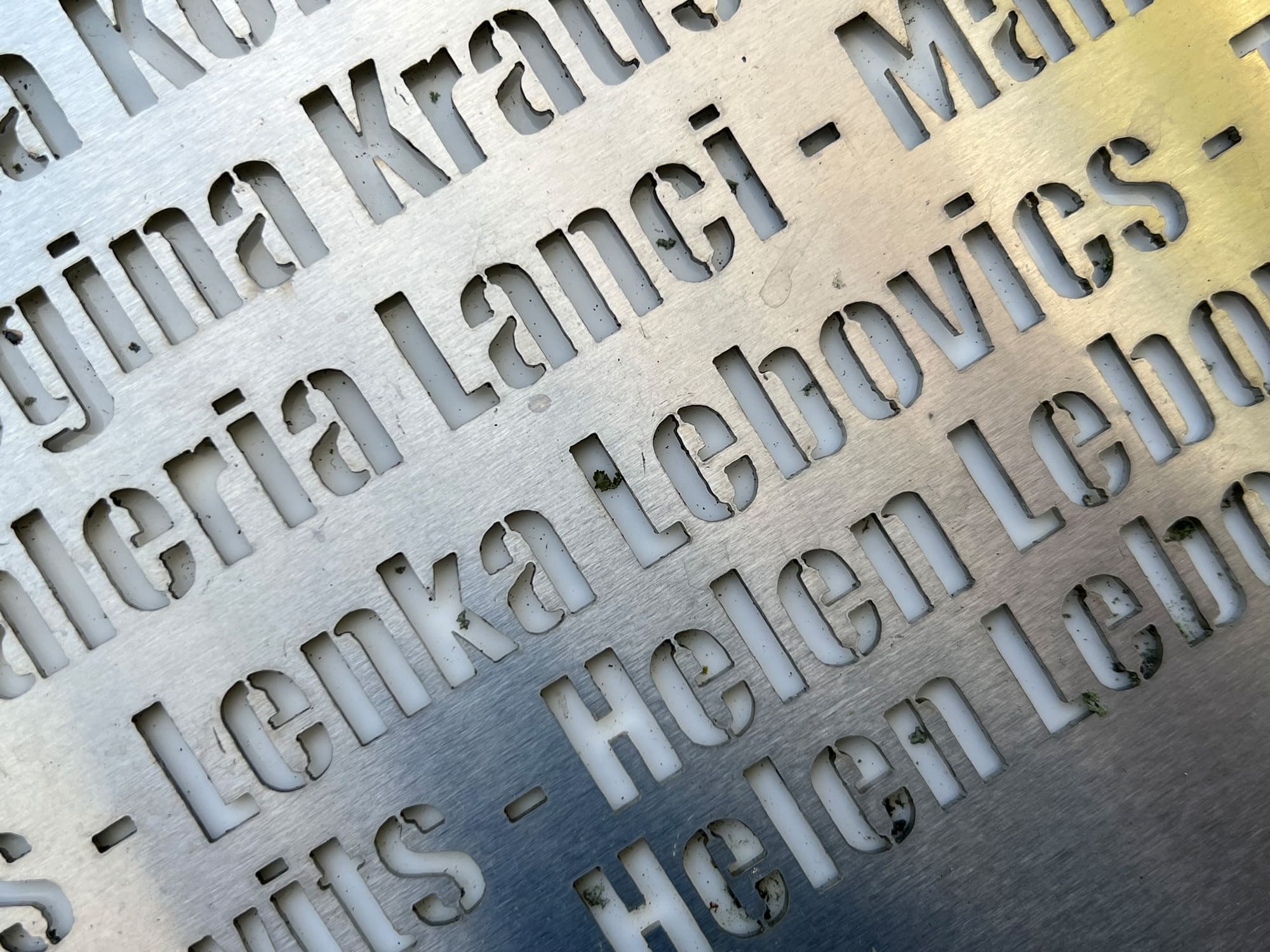
honoring
They experienced terrible things, survived the Shoah and came back to Geislingen 70 years later - wonderful people.The 5 Lebovics Sisters

Helen, Charlotte, Lenka, Rajzi and Rosalie survive the Shoah together. This is their story, written down by Rosalie in her book “Girl in a Striped Dress”, 2014. Her father, Israel Lebovic, born in 1897, was a kind, helpful fruit wholesaler. He worked a lot and therefore did not have much time for the family except on Shabbat, when everyone celebrated together. In 1919 he married Regina Meyerovitch, born in 1899, a strict Orthodox, who was a housewife and mother to her family of 9.
“We were not rich, but we were a family close to us. We had a peaceful and comfortable life and I was happy.” (Rosalie Lebovic Simon, Girl in a striped dress, 2014, p. 4)
Israel and Regina had seven children:
The first son, Yitzak, was born in 1920 and died while still a child. He was followed by 5 girls and another boy. Helen, b. 1923, was a professional award-winning designer and dressmaker who outfitted the entire town with her beautiful clothes. Charlotte, b. 1924, was very beautiful and the right hand of her mother. She helped her with all the household chores that needed to be done. Lenka, born in 1926, “the model”, was also a designer and dressmaker. She helped Helen. Rajzi, b. 1928, “the brain” was a math genius and straight-A student. Zev Wolf (William), b. 1930, suffered from rheumatoid arthritis and had a heart condition. For weeks he was hospitalized in Budapest and a good footballer when well. Rosalie, born in 1931, was also an interested and inquisitive student with very good grades. She was unable to attend high school and graduate because of the Holocaust, something she deeply regrets to this day. “I went to a Czechoslovak elementary school, which then became Ukrainian and then Hungarian. Fortunately, I was young and quickly adapted from one language to another.” (op. cit., p. 9)
All the girls wore very beautiful dresses sewn by the sisters themselves. The Lebovic family lived in Czechoslovakia: first in Velka Kriva, then Kosice, and finally in Teresva in the Carpathians, which is now in Ukraine. In March 1939 the town was occupied by the Hungarians and in 1941 the troubles began. Dozens of Jews from Teresva, among them 45-year-old Israel Lebovic, were drafted to Hungarian forced labor camps. They had to lay railroad tracks, build bridges and runways. One day in the summer of 1941, the police appeared to deport the family to Poland. But because they could prove that they were Hungarian citizens, they could still stay.
From 1943 Jewish children were no longer allowed to go to school and in early 1944 Jewish stores were closed and the yellow star had to be worn on clothing. But at least Father Isaac was able to return to the family. On April 14, 1944, the 6th day of Passover, the police again knocked on the Lebovic family’s door and told them that they had to present themselves at a certain farm the next day with only their most important belongings.
“How could we have chosen what to take with us? What should we leave behind? We didn’t know that our lives were in danger and that all those possessions meant nothing. … With tears in our eyes and broken hearts, we went out of the house, leaving behind our peace and happiness.” (op. cit. p. 15f.)
That very night the family was taken with the other Jews of the town to the Mateszalka Ghetto in Hungary. The ghetto was already overcrowded with thousands of people and so the Lebovic family had to sleep several nights in a cemetery. Only the food they had brought with them remained as provisions. Eight weeks later, the people of the ghetto were deported to Auschwitz in cattle cars, always 84 people to a car. Rosalie was the 85th and was placed separately from her family in another wagon. She was 12 years old at the time. Without her parents’ food, separated from her siblings, she was all alone and dependent on the help of strangers who gave her some of their meager rations. “Even today, when I hear a train on the tracks, the whistle of the engine, the memories of that train ride to the concentration camp Auschwitz – Birkenau come back.” (op. cit. p. 19)
After a few days of travel, the doors of the wagons were opened and immediately the shouting began: Schnell, schnell. Out! Dogs barked. Rosalie jumped out of the wagon and ran to her family. Regina Lebovic said: “Who knew that there were crematoria here? … I will not light the Shabbat candles tonight.” (op. cit. p. 19)
The Nazis took the decision about this away from her. At the age of 45 she was sent to the gas chamber where she suffocated and her body was then reduced to ashes in the crematoria. Rosalie looks the most like her mother of all her siblings. If she were still alive, she would look like Rosalie does today.


Auschwitz
Immediately after arrival at Auschwitz, the selection began. Rosalie and her mother were sent to the left, the father with the five other children to the right. The left was for those who were classified as not fit for work. A Jewish prisoner who had to help the SS whispered to Rajzi to throw away her glasses and Rosalie to tell them she was 16. Then suddenly, while Rosalie was walking to the left holding her mother’s hand, she broke away and ran to her sisters on the right. Her intention was that the mother should also be with the others again, but under the eyes of the SS the girls could not run together to the mother. No one knew that the people on the left side were going directly to the gas chamber. “Was it instinct, luck or God! I have absolutely no explanation. I was 12 years old at the time.” (op. cit., p. 22) Israel and the 6 children never saw Regina again. She was gassed on the same day she arrived in Auschwitz – Birkenau. William, then 13 years old, was also separated from his father and sent to the left. He met the same fate as his mother.
The 5 Lebovic girls had to undress with all the other women and girls, they were shaved off any body hair. Then each was given a blue – white striped prisoner’s dress, each with the prisoner’s number on it. Rosalie was prisoner # 20629.
Soon it was clear to everyone that Auschwitz was a place of death, hell on earth. During the roll call, the sisters – weakened by diarrhea and malnutrition – helped each other to remain standing until they had been counted. Especially the youngest inmate of Auschwitz, Rosalie at the age of 12, was constantly threatened with the gas chamber. More than once, Charlotte pulled Rosalie out of the left line of death. But once the four older girls were ordered to the right and Rosalie to the left. She was locked in, screaming hysterically, sure she was going to die when the door opened and Rosalie was exchanged for a mother who wanted to stay with her daughter. She ran to her sisters who were standing in rows of 5 in front of a train that was leaving Auschwitz. Her sisters persuaded another girl to switch places with Rosalie so the sisters could be together. But then they were selected again. Rosalie was shaking all over and was completely upset while Lenka tried to calm her down. Just before Dr Mengele came to them, Lenka took Rosalie’s hand and wanted to run directly with her to the train. But Charlotte wanted to preserve Lenka and Rosalie and ran off with Rosalie herself.
Miraculously, all five sisters found themselves on the train to Geislingen. “Charlotte told me, ‘We tried to help you, but in the end it was God who saved you.'” (op. cit., p. 39f.)
Geislingen / Steige
On the way to Geislingen, the five girls shared their bread with each other. When they arrived at the concentration camp in Geislingen, a satellite camp of Natzweiler -Struthof, they initially felt “like in heaven compared to Auschwitz” (op. cit., p. 41) Most importantly, they saw no flames or chimneys indicating crematoria. But still there were selections. A pregnant woman was driven out of the camp in a wheelbarrow. Shortly after, the wheelbarrow returned – empty. The woman was probably shot.
On Yom Kippur, the Jewish fast day, there was buttermilk and potatoes. The SS tried to dissuade the girls from their religious traditions. But they fasted anyway. Charlotte could get a few extra potatoes from the kitchen every now and then. One day she had just hidden some in her shirt again when the Gestapo searched everyone while they were counting. Rajzi, 15 years old, saw the panic in Charlotte’s face, took the potatoes without hesitation and ran to the nearest barracks to hide them. Then she quickly ran back to her place. No one betrayed her.
At dawn was Zählappel, at 6 o’clock began the day shift at WMF , it lasted until 6 pm. The night shift went from 6 pm to 6 am. The way from the camp to the arms factory was long. The girls wore their striped dresses, wooden shoes, but not even in winter they had underwear or a coat. During the march to work they had to sing German songs.
Adolf Schoofs
The boss of the Lebovic sisters was Adolf Schoofs, a small man with a mustache, 49 years old. He had a son whom he had dispossessed because he joined the NSDAP. His daughter Elsa was a year older than Rosalie. Schoofs encouraged Rosalie, “Rosita, remember, hold out, keep your mouth shut, hang in there.” (op. cit., p. 46) He called the girls by their names, and during night shifts he let them get some sleep and kept watch that they were not discovered. When Helen was sick, had asthma and coughed a lot, he brought her medicine. He shared his bread and acted like a respectable, highly decent man. Charlotte was once caught with potatoes. The SS Kapo yelled at her and wanted to report her, but Mr. Schoofs intervened. Even though he was much smaller, he confronted the SS and said, “If you have a heart, don’t report her. She is a good worker.” (op. cit., p. 47)
There was no work on Sundays and Mr. Schoofs came with his daughter Elsa to the front of the camp to show her what the Nazis were doing to innocent people. In March 1945, just two weeks before the liberation of Geislingen, the Lebovic sisters were evacuated with many others to Allach, a subcamp of Dachau. Mr. Schoofs, who had somehow found out, was waiting for the five sisters with food parcels. When he could not find them, he gave the package to someone else with the order to give it to the sisters. The package never reached them, his last gracious gift.
Liberation
After two or three weeks in Allach, which were almost as bad as in Auschwitz, except that there were no selections, the next cattle car was waiting for the sisters. The train ran for a day or two and then suddenly there were shots. The Americans freed the girls from the train. They were overjoyed. When there was more food again, Lenka became very sick. Charlotte took her to the US Army hospital. After Lenka was well again and everyone was a little stronger, they wanted to go home, to Teresva – still in their striped clothes, but with a few bags of bread.
When the train stopped in Prague, the girls were told that their father was in the hospital in Prague. He was emaciated to the bone and had hidden in an outhouse during the death march until he was liberated. After Israel was able to leave the hospital, Helen and Lenka stayed with him in Prague, while Charlotte, Rajzi and Rosalie went to Teresva – still wearing the striped clothes.
Survived
In Teresva, everything was destroyed. The Lebovics’ relatives all perished in the gas chambers. What was to become now? Where should they go? They decided to move to Usti nad Labem, where some relatives had survived. Each found work and they supported their father. Helen and Lenka sewed beautiful dresses again. Charlotte married Isaac Weiss, whose entire family had been murdered in Auschwitz. They went to Prague and then to a DP camp Gabersee, Bavaria and finally to Baltimore, Maryland. They had three daughters: Renee, Florence and Judy, 6 grandchildren and 5 great-grandchildren.
Lenka married Ervin Weksberg in 1946 and via Israel they moved to Canada, where Lenka lives today. She has a daughter and son, Rosanna and Fred, 5 grandchildren and 3 great-grandchildren. In September 1949 Helen, Rajzi, Rosalie (age 18) and their father emigrated to America. Rajzi married Sol in 1950 and Rosalie married his best friend Sidney in 1952. Helen married Morris Herman in 1955. They also moved to Montreal, Canada. Rajzi and Sol have three daughters, Rita, Renee and Debbie and 2 grandsons. Rosalie and Sidney had two sons and a daughter, Mitchell, Ruth and William. In 1972, Israel Lebovic died of a stroke.
All sisters are now widowed and still maintain a very close relationship with each other.
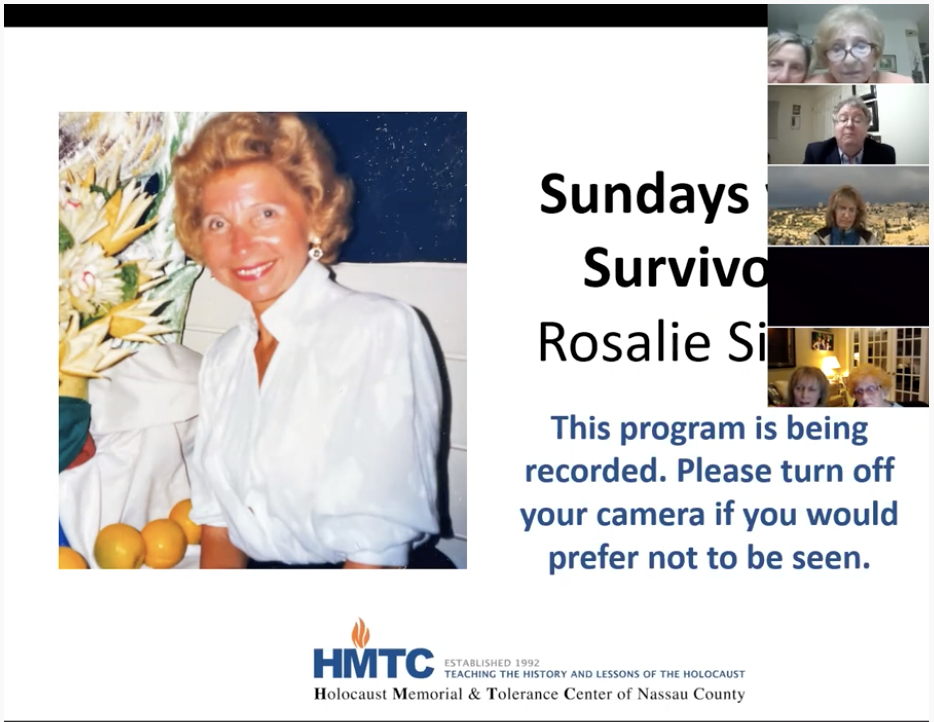
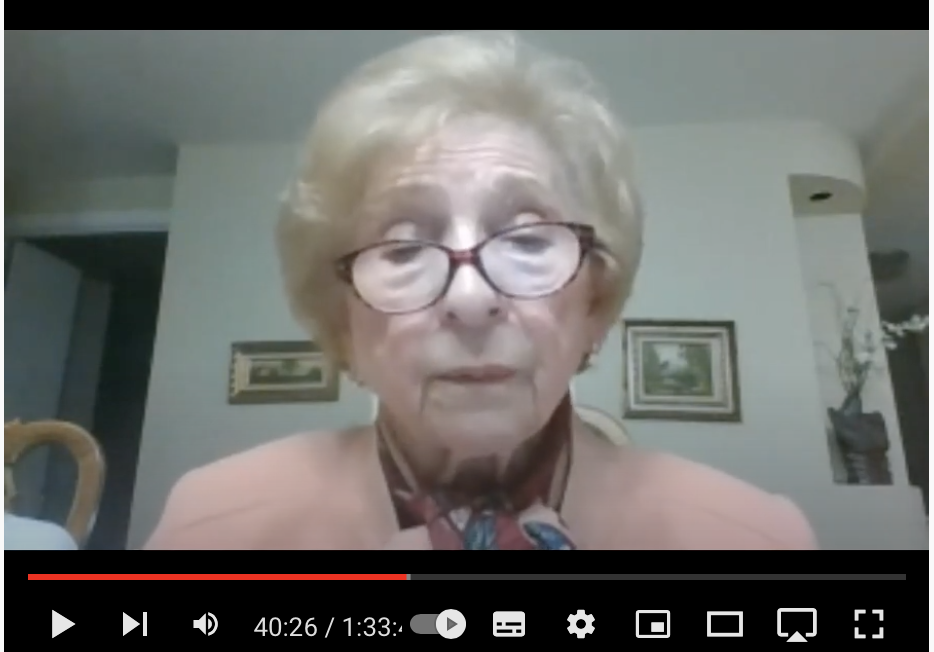
On January 23, 2022 Rosalie told her story via zoom at the “Sundays with Survivors” program of the Holocaust Memorial and Tolerance Center, HMTC, New York. This is the link:
You are currently viewing a placeholder content from YouTube. To access the actual content, click the button below. Please note that doing so will share data with third-party providers.
More Information